Commercial food prep facilities face aggressive organic breakdown under extreme desert heat. In Glendale food establishments across the Sahuaro District and Historic Downtown Glendale, kitchen sub-floors and floor sink…
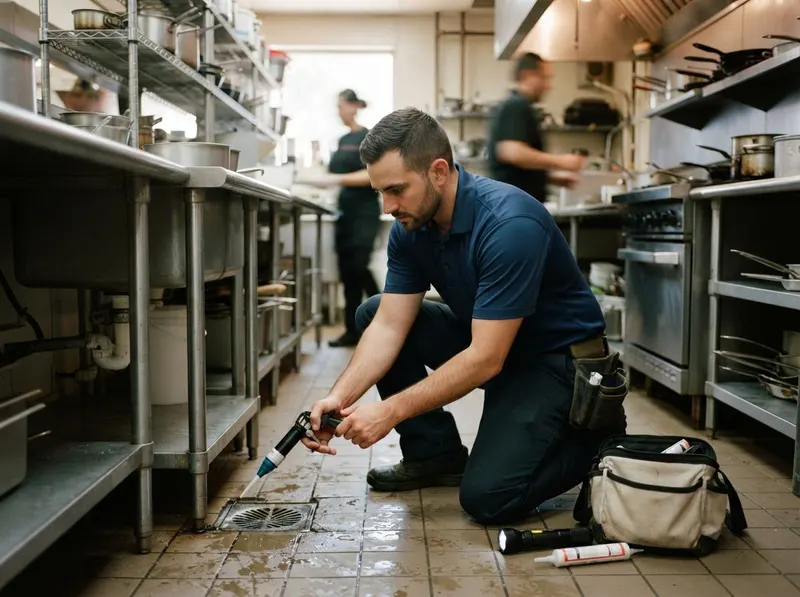
Commercial food prep facilities face aggressive organic breakdown under extreme desert heat. In Glendale food establishments across the Sahuaro District and Historic Downtown Glendale, kitchen sub-floors and floor sink assemblies endure constant exposure to grease, sugars, and rinse water. Ambient kitchen floor temperatures exceeding 85 degrees Fahrenheit accelerate microbial decomposition inside drain traps, creating a prime nursery for filth flies and secondary insect vectors. Standard chemical wash-downs strip superficial bacteria but fail to digest the underlying gelatinous biofilm inside drain stems. Veltrix Insect Services applies concentrated bacterial spores and targeted enzymes that liquefy lipid crusts down to bare pipe, eliminating the larval substrate where adult flies deposit eggs.
Operational differences dictate specific mechanical protocols. If an establishment operates an aged plumbing infrastructure, such as historic facilities in the Catlin Court Historic District or older commercial strips near Manistee Ranch, shifting tile grout and cracked sub-floor slabs allow wash water to pool below the reach of standard mops. In these environments, mechanical foaming disperses biological agents horizontally beneath low-clearance equipment lines, walk-in coolers, and floor-mounted shelving. Conversely, newer strip-mall kitchens near Arrowhead Ranch and Marshall Ranch feature high-volume grease interceptors where adult phorid flies enter through compromised venting seals; these sites require precise mechanical trap servicing and exterior gasket reinforcement alongside drain flushing.
Chemical space sprays deliver short-term knockdown of flying adults but leave the reproductive reservoir intact. The sustainable technical approach relies on physical-source elimination: dissolving the organic nursery, recalibrating UV light frequency traps away from open food preparation tables to prevent contamination, and establishing physical exclusion barriers around rear loading docks. Addressing moisture zones directly resolves persistent vector counts while keeping food-contact surfaces free of unauthorized residual pesticides, preserving structural compliance with Maricopa County Environmental Services health codes.
Every job gets a firm, written price after a free on-site visit.
Tell us about your commercial kitchen vector & fly control job in Glendale and we'll send a clear, written quote, usually the same day.
 Veltrix Insect Services