Stinging insect defense across the Salt River Valley requires distinguishing between open-comb foragers and defensive cavity-dwellers. In Glendale, Africanized honey bee genetics dominate wild feral swarms, displaying…
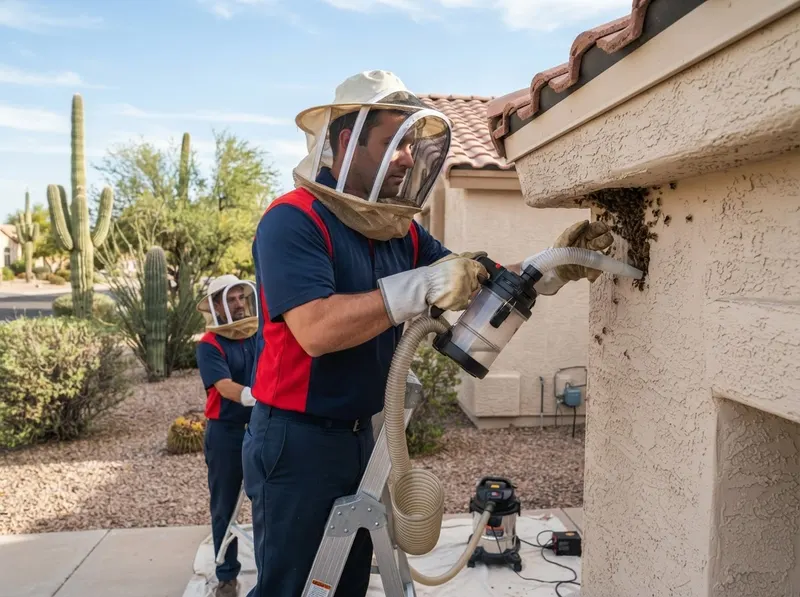
Stinging insect defense across the Salt River Valley requires distinguishing between open-comb foragers and defensive cavity-dwellers. In Glendale, Africanized honey bee genetics dominate wild feral swarms, displaying defensive perimeters exceeding 50 feet when colonies establish inside masonry or irrigation valve enclosures. Unlike native pollinators, an Africanized hive reacts rapidly to vibrational disturbances such as lawn equipment or opening patio sliders. Paper wasps construct umbrella-shaped, single-tier paper nests suspended under shaded roof eaves, metal patio framing, and tile overhangs. While paper wasps defend only their immediate nest structure, Africanized bees recruit hundreds of workers to pursue perceived threats across considerable distances.
Cavity nesting in Maricopa County follows distinct architectural patterns. Historic properties in Catlin Court and Manistee Ranch frequently experience hive colonization inside lath-and-plaster soffits, brick chimneys, and crawlspace vents. Modern slab-on-grade developments across Arrowhead Ranch, Marshall Ranch, and Bellair present vulnerabilities along Spanish barrel-tile roof returns, drywall voids accessed via weep holes, and unsealed utility penetrations near air compressor units. In neighborhoods like Hidden Manor, Ranch de Concepcion, and the Sahuaro District, mature eucalyptus and citrus canopies provide harborage for open-air swarms that migrate into structural fascia boards during peak April-to-October desert temperatures.
Decision-fit protocol balances structural integrity against chemical displacement. If an exposed paper wasp colony attaches under an exterior eave, precision contact knockdown and immediate manual scraping resolve the issue within 45 minutes with zero drywall disruption. When Africanized bees migrate into a structural cavity, simple surface aerosol spraying fails; trapped bees push deeper into living areas through recessed light fixtures and junction boxes, while abandoned honey melts in 115-degree heat, causing drywall rot and secondary carpet beetle infestations. Structural extraction requires localized opening of the stucco, fascia, or block void, absolute extraction of all comb, application of enzymatic masking agents, and structural re-sealing. The baseline operational minimum for any containment dispatch by Veltrix Insect Services is $200.
Every job gets a firm, written price after a free on-site visit.
Tell us about your africanized honey bee & paper wasp removal job in Glendale and we'll send a clear, written quote, usually the same day.
 Veltrix Insect Services